When Jesus had tasted it, he said, “It is finished!” Then he bowed his head and released his spirit. —John 19:30
The cross was the goal of Jesus from the very beginning. His birth was so there would be His death. The incarnation was for our atonement. He was born to die so that we might live. And when He had accomplished the purpose He had come to fulfill, He summed it up with a single word: “finished.”
In the original Greek, it was a common word. Jesus probably used it after He finished a project that He and Joseph might have been working on together in the carpentry shop. Jesus might have turned to Joseph and said, “Finished. Now let’s go have lunch.” It is finished. Mission accomplished. It is done. It is made an end of.
So what was finished? Finished and completed were the horrendous sufferings of Christ. Never again would He experience pain at the hand of wicked men. Never again would He have to bear the sins of the world. Never again would He, even for a moment, be forsaken of God. That was completed. That was taken care of.
Also finished was Satan’s stronghold on humanity. Jesus came to deal a decisive blow against the devil and his demons at the cross of Calvary. Hebrews 2:14 says, “Only by dying could he break the power of the devil, who hadthe power of death.” This means that you no longer have to be under the power of sin. Because of Jesus’ accomplishment at the cross, finished was the stronghold of Satan on humanity.
And lastly, finished was our salvation. It is completed. It is done. All of our sins were transferred to Jesus when He hung on the cross. His righteousness was transferred to our account.
So Jesus cried out the words, “It is finished!” It was God’s deliberate and well-thought-out plan. It is finished—so rejoice!
Jesus Christ made seven final statements during his last hours on the cross. These phrases are held dear by followers of Christ because they offer a glimpse into the depth of his suffering to accomplish redemption. Recorded in the Gospels between the time of his crucifixion and his death, they reveal his divinity as well as his humanity.
As much as possible, based on the approximate sequence of events portrayed in the Gospels, these seven last words of Jesus are presented here in chronological order.
1) Jesus Speaks to the Father
Luke 23:34 Jesus said, “Father, forgive them, for they do not know what they are doing.” (As translated according to the New International Version of the Bible, NIV.)
In his ministry, Jesus had proven his power to forgive sins. He had taught his disciples to forgive both enemies and friends. Now Jesus practiced what he had preached, forgiving his own torturers. In the midst of his excruciating suffering, the heart of Jesus focused on others rather than himself. Here we see the nature of his love—unconditional and divine.
2) Jesus Speaks to the Criminal on the Cross
Luke 23:43 “I tell you the truth, today you will be with me in paradise.” (NIV)
One of the criminals who was crucified with Christ had recognized who Jesus was and expressed faith in him as Savior. Here we see God’s grace poured out through faith, as Jesus assured the dying man of his forgiveness and eternal salvation. The thief would not even have to wait, as Jesus promised the man that he would share eternal life with Christ in paradise that very day. His faith secured him an immediate home in God’s kingdom.
3) Jesus Speaks to Mary and John
John 19:26–27 When Jesus saw his mother there, and the disciple whom he loved standing nearby, he said to his mother, “Dear woman, here is your son,” and to the disciple, “Here is your mother.” (NIV)
Jesus, looking down from the cross, was still filled with the concerns of a son for the earthly needs of his mother. None of his brothers were there to care for her, so he gave this task to the Apostle John. Here we clearly see Christ’s humanity.
4) Jesus Cries Out to the Father
Matthew 27:46 And about the ninth hour Jesus cried out with a loud voice, saying, “Eli, Eli, lama sabachthani?” that is, “My God, My God, why have You forsaken Me?” (As translated in the New King’s James Version, NKJV.)
Mark 15:34 Then at three o’clock, Jesus called out with a loud voice, “Eloi, Eloi, lema sabachthani?” which means “My God, my God, why have you abandoned me?” (As translated in the New Living Translation, NLT.)
In the darkest hours of his suffering, Jesus cried out the opening words of Psalm 22. And although much has been suggested regarding the meaning of this phrase, it was quite apparent the agony Christ felt as he expressed separation from God. Here we see the Father turning away from the Son as Jesus bore the full weight of our sin.
5) Jesus Is Thirsty
John 19:28 Jesus knew that everything was now finished, and to fulfill the Scriptures he said, “I am thirsty.” (NLT)
Jesus refused the initial drink of vinegar, gall, and myrrh (Matthew 27:34 and Mark 15:23) offered to alleviate his suffering. But here, several hours later, we see Jesus fulfilling the messianic prophecy found in Psalm 69:21: “They offer me sour wine for my thirst.” (NLT)
6) It Is Finished
John 19:30 … he said, “It is finished!” (NLT)
Jesus knew he was suffering the crucifixion for a purpose. Earlier he had said in John 10:18 of his life, “No one takes it from me, but I lay it down of my own accord. I have authority to lay it down and authority to take it up again. This command I received from my Father.” (NIV)
These three words were packed with meaning, for what was finished here was not only Christ’s earthly life, not only his suffering and dying, not only the payment for sin and the redemption of the world—but the very reason and purpose he came to earth was finished. His final act of obedience was complete. The Scriptures had been fulfilled.
7) Jesus’ Last Words
Luke 23:46 Jesus called out with a loud voice, “Father, into your hands I commit my spirit.” When he had said this, he breathed his last. (NIV)
Here Jesus closes with the words of Psalm 31:5, speaking to God the Father. We see his complete trust in his heavenly Father. Jesus entered death in the same way he lived each day of his life, offering up his life as the perfect sacrifice and placing himself in God’s hands.
Christians worldwide celebrate Holy Week every spring, commemorating the last eight days of Jesus’ life on earth. The time is a sacred one—an opportunity to reflect on and express gratitude to God for the most important events in the history of the world. The week begins on Palm Sunday and ends on Easter Sunday, each day set apart by various special services, readings, songs, and events.
What Days Comprise the Holy Week Timeline?
Palm Sunday honors the day when Jesus humbly rode into Israel’s capital city, cheered as the new King of the Jews—and as the Son of God who would usher in an eternal kingdom. A handful of days later, many who misinterpreted His mission called for His death. Jesus was sent to die by crucifixion on Friday and, through His sacrificial death, paid the price for the sins of humanity. On Sunday, He resurrected to new life, proving His claim as the Savior of the world who had the power to defeat death. Since that day, those who believe He came for that purpose are welcomed as children of God into eternal life.
The following lists the days of the Holy Week timeline and the events that took place on those days. While most churches have special programming for Palm Sunday, Good Friday, and Easter Sunday, others devote each day of Holy Week to special meals, songs, and prayers.
Palm Sunday
Jesus had been teaching about the kingdom of God and His identity as the Jewish Messiah for about three years when the time came for Him to formally and publicly make that claim in Israel’s capital of Jerusalem (John 12:12-15). When He arrived, people greeted Him with a famous ancient symbol of victory—palm branches. The thousands of Jews carrying the branches had heard Jesus’s teaching about God’s kingdom and had been beneficiaries of his miracles. Many believed that He came to usher in the new kingdom promised in the Old Testament. They had waited 400 years to hear from God. Now, here was who seemed to be God’s Son, claiming He was the king of Israel.
But even Jesus’ mode of transportation into the city—a lowly donkey rather than a majestic warhorse—revealed the Jews’ misaligned expectations. Centuries of prophecies had suggested the Messiah would come and overthrow the Roman government and bring Israel back to the glory it enjoyed under King David (Psalm 110, Isaiah 2:2, Isaiah 11:12, Ezekiel 37:24). But the kingdom God was introducing was an eternal, universal kingdom, not a local, political movement. Just as Jesus’ birth was marked by unadorned humility, so would be the rest of His short time on earth.
During Palm Sunday services, churches across the world gather to wave palm branches as a nod to Jesus’ triumphal entry. The leaves can also be dried and woven into small, handheld crosses. More traditional churches might sing noted Palm Sunday hymns such as “All Glory Laud and Honor.”
Holy Monday
Jesus had spent the evening of Palm Sunday out of the city, and upon return the next day, he taught in the temple of Jerusalem. He shared parables that used simple imagery to explain the kingdom of God. The Jewish leaders thought he was being blasphemous by doing so and questioned him (Matthew 21:23). Later, as he walked through the temple, Jesus became angry that the holy place of worship had become a place for buying and selling—and taking advantage of the poor. In his zeal, he overturned tables, enraging the vendors (Matthew 21:12-16). Then he spent the evening with his friends Lazarus, Mary, and Martha (Matthew 21:17).
It is here, at the beginning of the week, that Jesus increases and intensifies His public messages. The Gospels record the outrage of the leaders of the day, and we are meant to recognize that Jesus’ death on Good Friday will not be accidental or unexpected. Instead, Jesus deliberately stirs up the anger of those who wish to kill Him because He fully understands His mission as a sacrifice for the sins of the world.
The magnitude of Jesus’ messages contrasts with His decision to reconnect with several close friends. This was doubtless an encouragement to the three siblings in question and Jesus Himself as He processed what lay ahead of Him. Jesus had declared Himself to be “the resurrection and the life” shortly before raising Lazarus from the dead—a clear foreshadowing of His own death and resurrection.
The Eastern Orthodox Church observes Holy Monday with Bible readings and special hymns recounting the day’s events.
Holy Tuesday
Gospel accounts suggest that on Tuesday, Jesus continued to publicize His message by teaching parables in the temple. The parable of the tenants in particular (Matthew 21:33-44) depicts a dramatic and even violent reflection of Jesus’ eventual sacrifice—an assignment from His Heavenly Father. Jesus also addresses the end times, the kingdom of God, the hypocrisy of those who claim to fear God, and what to expect when the Son of Man comes. In each parable, He speaks with certainty and gravity. Once again, Jesus’ authority to teach in such a way is questioned. This time, the chief priests seek to arrest Jesus after sensing He is speaking against them (Matthew 21:45). At this point, the crowd still reveres Jesus, so these plans are put on hold.
Each of these events is designed to show the reader that Jesus was the Son of God and that He knew it. No one could accuse Jesus of being a humble teacher indignant at the thought of being worshiped. Instead, Jesus invites this recognition of His deity (Matthew 24:25, Matthew 26:1).
Though not as highly celebrated as some of the other weekdays, the Catholic Church observes Holy Tuesday with relevant Scripture readings and hymns. In Mexico and Spain, Tuesday marks another day of Semana Santa (“Holy Week”), in which schools and many businesses are closed to allow for an extended celebration.
Holy Wednesday
Jesus’ popularity had reached an apex with His entry into Jerusalem (John 12:19), and the Jewish religious leaders ramped up their efforts to rid themselves of Him. Between (alleged) blasphemy, public miracles, and blatant attacks on the religious establishment, they had now compiled what they believed was sufficient reason to take action. On Wednesday, plans were set in motion to capture Jesus—and kill Him. In the words of Caiaphas, who was the high priest that year, “You do not realize that it is better for you that one man die for the people than that the whole nation perish” (John 11:49-53). Later, Jesus is anointed by Mary at Bethany, with an expensive jar of perfume that Jesus later suggests is a preparation for His burial.
Understandably, Jewish leaders were angered at Jesus’ claim to be the Son of God and may have feared that they would lose power and authority if Jesus were to “come to power.” Yet Jesus was very popular with many people, and his miracles were hard to explain away. They needed to find and arrest him, but how? Their question was answered when Judas Iscariot, one of Jesus’ disciples, approached them with an offer to hand over Jesus for 30 pieces of silver. Judas’ possible motives have been debated throughout the centuries. One thing is for certain: his involvement meant the chief priests didn’t require any extended searches for Jesus the next evening.
This day is also sometimes referred to as Good Wednesday, or Great and Holy Wednesday, by Eastern Christian churches. In the West, it’s sometimes called Spy Wednesday. In countries such as the Czech Republic, Wednesday is used to give homes a thorough cleaning in preparation for Easter Sunday.
Holy Thursday
To some, Maundy Thursday may seem like an archaic, mysterious name. Is it a noun? An adjective? What does it have to do with Jesus? It turns out that maundy comes from the Latin mandatum, where we get the word “mandate” (a word much more familiar to us). The mandate, or command, in question is Jesus’ command that His followers love one another (John 13:34). How fascinating that while other moments from this historical day often get more attention—the Last Supper, the washing of the disciples’ feet, Judas’ swift exit from the table—the early church made Jesus’ new command the namesake for Maundy Thursday.
Many Christians reenact the Last Supper with a traditional seder meal similar to the one Jesus would have shared with His disciples; in this scenario, the words of Jesus are uttered by the priest or pastor. (Foods eaten can include a lamb shank bone, bitter herbs, and salted vegetables.) This special service can also include a foot-washing ceremony.
Some churches (particularly Lutherans and Catholics) will choose to offer a Tenebraeservice (Tenebrae means “Shadow”). Here, the sanctuary’s candles or lights are gradually extinguished as clergy strip the altar of its linens. This can be accompanied by a loud noise at the end, meant to encourage meditation on the sufferings of Christ. Tenebrae may also start three days of special services, known as triduum.
Good Friday
The Gospel writers create a stark contrast between Palm Sunday and Good Friday, between the crowds shouting “Hosanna!” and “Crucify him!”
After Judas betrays Jesus (identifying Him to Roman guards with a kiss), Jesus is quickly carted through one ordeal after another. First, He is taken to the Jewish high priest, Caiaphas, who is joined by other elders and religious leaders (Matthew 26:57, 59-60). It is here that Jesus is physically assaulted for the first time (Matthew 26:67-68).
The Jewish leaders realize that their own laws prohibit them from killing Jesus themselves, so they hand Him over to the Roman governor. Pontius Pilate tells the Jews that he “finds no fault in” Jesus (John 18:28-38). Their rabid response sends him back inside to speak with Jesus once more, eventually relenting to Jesus’ death sentence. Jesus is whipped with various sharp, maiming implements, then mocked by soldiers (John 19:1-3). Betrayed by His friends and His nation, He now endures increasing physical and social agony.
Tucked within the three-hour ordeal of Jesus’ death are many significant fulfillments of Old Testament prophecies (Psalm 22, Isaiah 53, etc.) These contain details about the manner of His physical death (being nailed to a cross), ridicule from onlookers, and separation from God due to taking on the sins of humanity.
Many churches hold special Good Friday services that feature “Stations of the Cross,” interspersing special prayers with passages from the accounts of Jesus’ arrest, trial, and death. Similarly, “passion plays” feature multiple church members reenacting the words and actions of Jesus, Peter, Pontius Pilate, and others. In the Philippines, more graphic commemorations involve flagellation (whipping) and crucifixion reenactments. Periods of fasting and total silence are also common.
Holy Saturday
The Gospels are somewhat silent about what happened on Holy Saturday. In fact, only Matthew gives explicit details about the day’s events (Matthew 26:62-66). The details about the guard at the tomb are imperative when reflecting on the numerous alternative explanations for the empty tomb that have circulated for centuries. Matthew’s account makes it plain that no one could have overtaken both the Roman guard and the stone that took several men to move in the first place. Moreover, archaeology and Jewish history reveal that to enter a traditional tomb of that time, one had to stoop down and essentially crawl in—not walk in and out upright.
We know from the disciples’ that they likely remained in hiding, fearing punishment from the Romans or the Jewish elite. Like anyone who buries a beloved friend, they would’ve been in a state of mourning, likely too shocked to go about their business. The fact that it was the Sabbath meant that the rest of the community would’ve been somewhat quiet, even after the harrowing events of Friday.
Holy Saturday is also sometimes known as Easter Vigil. Some churches will hold prayer vigils and light commemorative candles. However, since Holy Saturday technically marks the end of Lent, certain churches take a more joyous approach with the celebratory ringing of bells. At home, some will prepare for the next day’s Easter celebration.
Easter Sunday
Finally, we come to one of the most important days on the Christian calendar and the culmination of the Holy Week timeline. The first Easter morning began quietly, not with the fanfare now associated with the holiday. Like Jesus’ birth, the day involved several unlikely witnesses to a miracle and an appearance and message from an angel. In one Gospel account, two of Jesus’ female followers arrive at the tomb to pay their respects. Suddenly, an earthquake rattles the ground, and an angel arrives on the scene to calm their fears, remind them of Jesus’ promise to rise again on the third day, and to tell the other disciples of the good news. Later, Jesus appears to the remaining disciples, further proving His status as the Son of God. Though He suffered from unspeakable wounds on Friday, His body only shows signs of three nail piercings and a spear wound.
Easter’s overwhelming worldwide popularity (even among nominal Christians or non-Christians) means there’s no shortage of Sunday festivities—or beloved foods. Here are several international favorites:
Hot cross buns (New Zealand, United Kingdom, etc.)
Babka, or bread with raisins (Poland)
Colomba de pasqua, a dove-shaped sweet bread (Italy)
The Holy Week Timeline that holds events from the end of Jesus’ life changed the course of history, offering hope to those who now, through faith in His sacrifice, are called children of God.
Anna Oelerich is a Chicago-area church youth director, freelance writer, and graduate of Taylor University. She received her B.S. in Professional Writing in 2018, but has loved words—reading, storytelling, list-making, and even handwriting—for as long as she can remember. Previously, she served as the marketing and communications coordinator for a community foundation, where she shared powerful stories of generosity, and encouraged others to give. When writing an article, or developing programming for her students, Anna enjoys highlighting the historical and cultural contexts of familiar Bible passages so others feel they are living the stories for themselves.
I didn’t grow up in a church that noted or celebrated Maundy Thursday. I recall seeing the name and being at least vaguely familiar enough with the term to associate it with Holy Week and the days leading up to Easter Sunday. To define it or understand it, however, I was lost.
Palm Sunday and Easter Sunday are noted for their celebration. Bookending the week, Jesus entered Jerusalem heralded as a king to start and was pronounced, “Alive!” at the empty tomb at the week’s conclusion. Days like Maundy Thursday and Good Friday and the Passion Week events they note, however, are far more somber and contemplative. It is often Catholics or more liturgical Protestants who observe Maundy Thursday although it can be quite common in other evangelical conversations and might even be growing in popularity. Do you know what it means and where the name is derived?
It wasn’t until adulthood and the start of my ministry journey that I uncovered the idea behind Maundy Thursday or participated in any traditional observances and gathered services regarding it. It wasn’t until a deeper inquiry that I discovered the meaningful connection. It being Easter, let’s chase a rabbit for a moment and scout out some connections.
The name maundy comes from the Latin word mandatum which means command and, you guessed it, is where we grab the word mandate. The longer phrase, mandatum novum do vobis, is translated as, “A new command I give you,” and finds its home in Jesus’ words in John 13. On the evening he was arrested, Jesus instructed his disciples [sans Judas] with these words:
“I give you a new command: Love one another. Just as I have loved you, you are also to love one another. By this everyone will know that you are my disciples, if you love one another.”
John 13:34-35
Maundy Thursday, in terms of the Passion Week timeline, marks the night Jesus celebrated the Passover seder with his disciples in the upper room. You can read about that particular event in the following Gospel passages (Matthew 26:17-30; Mark 14:12-26; Luke 22:7-38; & John 13).
The holiday that they were honoring and remembering, however, dated back to Israel’s plight in Egypt, chronicled by Moses in the Old Testament book Exodus. It was God’s rescue from slavery under Pharaoh that Israel remembered. Going forward, it would be rescue from slavery to sin that believers cherish. The death of Egypt’s firstborns while Israel’s sons were “passed over” paved the perfect way for God to illustrate His grand design to place our sin’s sentence on His firstborn Son while we are quite literally spared. The Passover was all about rescue and it painted a picture of eternal choosing and precious salvation. Following this powerful moment of rescue in Exodus, God offered to His ransomed people his Holy commands.
Piecing together the gospel accounts, you know that Christ was anointed in a beautiful display of extravagant worship, and then humbly turned the towel toward his band of disciples, washing their feet one by one. Now prior to His great act of sacrifice, a new command was attached. John 3:16 outlines so beautifully why Jesus came and ultimately why Jesus suffered. The apostle wrote that God “so loved the world that he gave his one and only Son.” Christ’s service oriented display and eventually his sacrificial death, thus, become the pictures of love we’ve been commanded to portray.
“While Good Friday and Resurrection Sunday garnish the lion share of our attention, bypassing Maundy Thursday, we miss something that matters. Love. It’s how His light is shown and how the world will see Him and come to trust Him.”
Nic Allen
So, on Maundy Thursday, leading up to Easter, whether you enjoy an elaborate seder or simply read and meditate on the story of Jesus, how will you employ that Holy command to love as Jesus loved. Perhaps participating in Holy Communion, the priority should probably be examining His Holy Command. Consider the following questions:
Does my schedule and the ways I invest my interest, direct my work, and spend my time afford me opportunities to show others love?
Does the way I speak to others, address issues, and even conduct myself on social media reflect the love of Jesus in a service oriented, sacrificial, humble way?
Do my relationships reflect my discipleship, indicating a life of love that sparks the world’s interest in Jesus?
Remember these words. In Christ’s longest and most famous recorded discourse, the Sermon on the Mount, Jesus said,
“In the same way, let your light shine before others, that they may see your good deeds and glorify your Father in heaven.”
Matthew 5:16
Peter took those words to heart and wrote in his epistle, “Conduct yourselves honorably among the Gentiles, so that when they slander you as evildoers, they will observe your good works and will glorify God on the day he visits” (1 Peter 2:12).
Jesus so aptly explained in John’s recoding, “By this everyone will know that you are my disciples, if you love one another” (John 13:35).
Paul prescribed, “I will show you an even better way,” and, “the greatest of these is love” (1 Corinthians 12:31 and 13:13).
Leading up to Easter, are you leaning into love? As Christians everywhere honor Christ’s death and celebrate the resurrection, we would do well to remember first and foremost His holy command, that we love one another. While Good Friday and Resurrection Sunday garnish the lion share of our attention, bypassing Maundy Thursday, we miss something that matters. Love. It’s how His light is shown and how the world will see Him and come to trust Him.
The very best way to celebrate Easter this year might just be obedience. Jesus said that too. “If you love me, you will keep my commands” (John 14:15). So, via mandatum novum do vobis, it would seem that the Easter axiom we should focus on most is the command to love. With that mandate, we indicate how much we love Christ and we illustrate how very much God loves the world.
Nic Allen resides in Nashville, Tenn., and pastors the Nashville Campus of Rolling Hills Community Church. He and his wife Susan have been married for 21 years and have three children, ages 9, 14, and 15.
Christ’s death and resurrection is a core value of Christianity. The resurrection is the focal point of every truth Christ taught His disciples while on Earth. He said, “I am the resurrection and the life. The one who believes in me will live, even though they die” (John 11:25). It was the resurrection that turned Jesus’ brokenhearted followers into courageous witnesses and martyrs who, in just a few years, would spread the gospel across the Roman Empire and beyond. The resurrection proclaimed the fact that when Jesus died, so did death. Here are three reasons why Christ died:
Jesus died to buy you back from the bondage of sin. Jesus told His disciples that He must die, and He told them why: “The Son of Man did not come to be served, but to serve, and to give his life as a ransom for many” (Matthew 20:28). When Adam and Eve sinned in the Garden of Eden, mankind came under the bondage of Satan, sin, and death. Jesus’ death paid the ransom price that was necessary to satisfy God’s holiness and justice. God’s holiness required that the penalty be paid, and God’s love provided that payment in the death of the Son ( John 3:16). Jesus’ perfect life was the only sacrifice that could be offered that would satisfy God’s justice. Jesus died so you don’t have to die.
Jesus died to prove His power over death. Jesus had to die not only to pay the penalty for our sin, but also to show His power over death. The apostle Paul said Jesus “was appointed the Son of God in power by his resurrection from the dead”(Romans 1:3-4). Jesus’ resurrection from the dead proves He is God and that He possesses eternal life, and that He can therefore give this same eternal life to all who believe in Him.
Jesus died to defeat death. At first glance, Satan appeared to be victorious in the Garden of Eden (Genesis 3). Adam and Eve had disobeyed God, and their sin resulted in immediate spiritual death and ultimate physical death. Even at the cross, when Jesus died, Satan seemed to have won. But God turned Satan’s apparent victory into defeat when Jesus rose from the dead. Death is no longer a source of dread or fear for us—it “has been swallowed up in victory” (1 Corinthians 15:54). Christ overcame death, and a day is coming when all those who are in Christ will overcome it, too.
Are you a believer in Christ? If so, you will not experience spiritual death. With that in mind, take to heart the apostle Paul’s challenge to “stand firm. Let nothing move you. Always give yourselves fully to the work of the Lord, because you know that your labor in the Lord is not in vain” (1 Corinthians 15:58).
RESPOND:
Thank You, Lord, for the resurrection and the reality that death is defeated! Amen
RENEWING RESOURCES:
Commit your heart and life to Christ now, with the goal of becoming a man after God’s own heart–you’ll find it the most rewarding pursuit ever!
REFLECT:
Take time to thank God for what His death and resurrection means to you.
REMEMBER:
Christ’s resurrection is a core value of Christianity.
In 567, the Council of Tours “proclaimed the twelve days from Christmas to Epiphany (that is, through the end of 5 January, as Epiphany begins the following day) as a sacred and festive season, and established the duty of Advent fasting in preparation for the feast.”[9][10][11][12] Christopher Hill, as well as William J. Federer, states that this was done in order to solve the “administrative problem for the Roman Empire as it tried to coordinate the solarJulian calendar with the lunar calendars of its provinces in the east.”[clarification needed][13][14]
The Oriental Orthodox (other than the Armenians), the Eastern Orthodox, and the Eastern Catholics who follow the same traditions have a twelve-day interval between the two feasts. Christmas and Epiphany are celebrated by these churches on 7 and 19 January using the Julian calendar, which correspond to 25 December and 6 January using the Gregorian calendar. The Twelve Days, using the Julian calendar, end at sunset on 18 January.
For the Eastern Orthodox, both Christmas and Epiphany are among the Twelve Great Feasts that are only second to Easter in importance.[16]
The period between Christmas and Epiphany is fast-free.[16] During this period one celebration leads into another. The Nativity of Christ is a three-day celebration: the formal title of the first day (i.e. Christmas Eve) is “The Nativity According to the Flesh of our Lord, God and Saviour Jesus Christ”, and celebrates not only the Nativity of Jesus, but also the Adoration of the Shepherds of Bethlehem and the arrival of the Magi; the second day is referred to as the “Synaxis of the Theotokos“, and commemorates the role of the Virgin Mary in the Incarnation; the third day is known as the “Third Day of the Nativity”, and is also the feast day of the Protodeacon and ProtomartyrSaint Stephen. 29 December is the Orthodox Feast of the Holy Innocents. The Afterfeast of the Nativity (similar to the Western octave) continues until 31 December (that day is known as the Apodosis or “leave-taking” of the Nativity).
On 2 January begins the Forefeast of the Theophany. The Eve of the Theophany on 5 January is a day of strict fasting, on which the devout will not eat anything until the first star is seen at night. This day is known as Paramony (Greek Παραμονή “Eve”), and follows the same general outline as Christmas Eve. That morning is the celebration of the Royal Hours and then the Divine Liturgy of Saint Basil combined with Vespers, at the conclusion of which is celebrated the Great Blessing of Waters, in commemoration of the Baptism of Jesus in the Jordan River. There are certain parallels between the hymns chanted on Paramony and those of Good Friday, to show that, according to Orthodox theology, the steps that Jesus took into the Jordan River were the first steps on the way to the Cross. That night the All-Night Vigil is served for the Feast of the Theophany.
Within the Twelve Days of Christmas, there are celebrations both secular and religious.
Christmas Day, if it is considered to be part of the Twelve Days of Christmas and not as the day preceding the Twelve Days,[3] is celebrated by Christians as the liturgical feast of the Nativity of the Lord. It is a public holiday in many nations, including some where the majority of the population is not Christian. On this see the articles on Christmas and Christmas traditions.
New Year’s Eve (31 December) is the feast of Pope St. Sylvester I and is known also as “Silvester“. The transition that evening to the new year is an occasion for secular festivities in many nations, and in several languages is known as “St. Sylvester Night” (“Notte di San Silvestro” in Italian, “Silvesternacht” in German, “Réveillon de la Saint-Sylvestre” in French, and “סילבסטר” in Hebrew).
New Year’s Day (1 January) is an occasion for further secular festivities or for rest from the celebrations of the night before. In the Roman Rite of the Roman Catholic Church, it is the Solemnity of Mary, Mother of God, liturgically celebrated on the Octave Day of Christmas. It has also been celebrated, and still is in some denominations, as the Feast of the Circumcision of Christ, because according to Jewish tradition He would have been circumcised on the eighth day after His Birth, inclusively counting the first day and last day. This day, or some day proximate to it, is also celebrated by the Roman Catholics as World Day of Peace.[17]
In many nations, e. g., the United States, the Solemnity of Epiphany is transferred to the first Sunday after 1 January, which can occur as early as 2 January. That solemnity, then, together with customary observances associated with it, usually occur within the Twelve Days of Christmas, even if these are considered to end on 5 January rather than 6 January.
The Second Council of Tours of 567 noted that, in the area for which its bishops were responsible, the days between Christmas and Epiphany were, like the month of August, taken up entirely with saints’ days. Monks were therefore in principle not bound to fast on those days.[18] However, the first three days of the year were to be days of prayer and penance so that faithful Christians would refrain from participating in the idolatrous practices and debauchery associated with the new year celebrations. The Fourth Council of Toledo (633) ordered a strict fast on those days, on the model of the Lenten fast.[19][20]
Twelfth Night (The King Drinks) by David Teniers c. 1634–1640
In England in the Middle Ages, this period was one of continuous feasting and merrymaking, which climaxed on Twelfth Night, the traditional end of the Christmas season on 5 January (the last night before Ephiphany which started 6 January). William Shakespeare used it as the setting for one of his most famous stage plays, Twelfth Night. Often a Lord of Misrule was chosen to lead the Christmas revels.[21]
Some of these traditions were adapted from the older pagan customs, including the RomanSaturnalia and the Germanic Yuletide.[22] Some also have an echo in modern-day pantomime where traditionally authority is mocked and the principal male lead is played by a woman, while the leading older female character, or ‘Dame’, is played by a man.
The early North American colonists brought their version of the Twelve Days over from England, and adapted them to their new country, adding their own variations over the years. For example, the modern-day Christmas wreath may have originated with these colonials.[23][24] A homemade wreath would be fashioned from local greenery, and fruits, if available, were added. Making the wreaths was one of the traditions of Christmas Eve; they would remain hung on each home’s front door beginning on Christmas Night (first night of Christmas) through Twelfth Night or Epiphany morning. As was already the tradition in their native England, all decorations would be taken down by Epiphany morning and the remainder of the edibles would be consumed. A special cake, the king cake, was also baked then for Epiphany.
Many in the UK and other Commonwealth nations still celebrate some aspects of the Twelve Days of Christmas. Boxing Day, 26 December, is a national holiday in many Commonwealth nations. Victorian era stories by Charles Dickens, and others, particularly A Christmas Carol, hold key elements of the celebrations such as the consumption of plum pudding, roasted goose and wassail. These foods are consumed more at the beginning of the Twelve Days in the UK.
Twelfth Night is the last day for decorations to be taken down, and it is held to be bad luck to leave decorations up after this.[25] This is in contrast to the custom in Elizabethan England, when decorations were left up until Candlemas; this is still done in some other Western European countries such as Germany.
In the United States, Christmas Day is a federal holiday which holds additional religious significance for Christians.[26]
The traditions of the Twelve Days of Christmas have been nearly forgotten in the United States. Contributing factors include the popularity of the stories of Charles Dickens in nineteenth-century America, with their emphasis on generous giving; introduction of secular traditions in the 19th and 20th centuries, e. g., the American Santa Claus; and increase in the popularity of secular New Year’s Eve parties. Presently, the commercial practice treats the Solemnity of Christmas, 25 December, the first day of Christmas, as the last day of the “Christmas” marketing season, as the numerous “after-Christmas sales” that commence on 26 December demonstrate. The commercial calendar has encouraged an erroneous assumption that the Twelve Days end on Christmas Day and must therefore begin on 14 December.[27]
Christians who celebrate the Twelve Days may give gifts on each of them, with each of the Twelve Days representing a wish for a corresponding month of the new year. They may feast on traditional foods and otherwise celebrate the entire time through the morning of the Solemnity of Epiphany. Contemporary traditions include lighting a candle for each day, singing the verse of the corresponding day from the famous The Twelve Days of Christmas, and lighting a yule log on Christmas Eve and letting it burn some more on each of the twelve nights. For some, the Twelfth Night remains the night of the most festive parties and exchanges of gifts. Some households exchange gifts on the first (25 December) and last (5 January) days of the Twelve Days. As in former times, the Twelfth Night to the morning of Epiphany is the traditional time during which Christmas trees and decorations are removed.[citation needed]
^ Hatch, Jane M. (1978). The American Book of Days. Wilson. ISBN9780824205935. January 5th: Twelfth Night or Epiphany Eve. Twelfth Night, the last evening of the traditional Twelve Days of Christmas, has been observed with festive celebration ever since the Middle Ages.
^ Alexander, J. Neil (1 September 2014). Days, Weeks, and Seasons. Church Publishing. ISBN978-0-89869-874-9. There are, in fact, twelve days between Christmas Day and the eve of the Epiphany on January 5.
^ Jump up to:ab Bratcher, Dennis (10 October 2014). “The Christmas Season”. Christian Resource Institute. Retrieved 20 December 2014. The Twelve Days of Christmas … in most of the Western Church are the twelve days from Christmas until the beginning of Epiphany (January 6th; the 12 days count from December 25th until January 5th). In some traditions, the first day of Christmas begins on the evening of December 25th with the following day considered the First Day of Christmas (December 26th). In these traditions, the twelve days begin December 26[th] and include Epiphany on January 6[th].
^ Jump up to:ab“The Book of Common Prayer” (PDF). New York: Church Publishing Incorporated. January 2007. p. 43. Retrieved 24 December 2014. On the Twelve Days of Christmas Alleluia. Unto us a child is born: O come, let us adore Him. Alleluia.
^ Truscott, Jeffrey A. Worship. Armour Publishing. p. 103. ISBN9789814305419. As with the Easter cycle, churches today celebrate the Christmas cycle in different ways. Practically all Protestants observe Christmas itself, with services on 25 December or the evening before. Anglicans, Lutherans and other churches that use the ecumenical Revised Common Lectionary will likely observe the four Sundays of Advent, maintaining the ancient emphasis on the eschatological (First Sunday), ascetic (Second and Third Sundays), and scriptural/historical (Fourth Sunday). Besides Christmas Eve/Day, they will observe a 12-day season of Christmas from 25 December to 5 January.
^ Fr. Francis X. Weiser. “Feast of the Nativity”. Catholic Culture. The Council of Tours (567) proclaimed the twelve days from Christmas to Epiphany as a sacred and festive season, and established the duty of Advent fasting in preparation for the feast. The Council of Braga (563) forbade fasting on Christmas Day.
^ Fox, Adam (19 December 2003). “‘Tis the season”. The Guardian. Retrieved 25 December 2014. Around the year 400 the feasts of St Stephen, John the Evangelist and the Holy Innocents were added on succeeding days, and in 567 the Council of Tours ratified the enduring 12-day cycle between the nativity and the epiphany.
^ Hynes, Mary Ellen (1993). Companion to the Calendar. Liturgy Training Publications. p. 8. ISBN9781568540115. In the year 567 the church council of Tours called the 13 days between December 25 and January 6 a festival season. Martindale, Cyril Charles (1908). “Christmas”. The Catholic Encyclopedia. New Advent. Retrieved 15 December 2014. The Second Council of Tours (can. xi, xvii) proclaims, in 566 or 567, the sanctity of the “twelve days” from Christmas to Epiphany, and the duty of Advent fast; …and that of Braga (563) forbids fasting on Christmas Day. Popular merry-making, however, so increased that the “Laws of King Cnut”, fabricated c. 1110, order a fast from Christmas to Epiphany.
^ Bunson, Matthew (21 October 2007). “Origins of Christmas and Easter holidays”. Eternal Word Television Network (EWTN). Retrieved 17 December 2014. The Council of Tours (567) decreed the 12 days from Christmas to Epiphany to be sacred and especially joyous, thus setting the stage for the celebration of the Lord’s birth…
^ Hill, Christopher (2003). Holidays and Holy Nights: Celebrating Twelve Seasonal Festivals of the Christian Year. Quest Books. p. 91. ISBN9780835608107. This arrangement became an administrative problem for the Roman Empire as it tried to coordinate the solar Julian calendar with the lunar calendars of its provinces in the east. While the Romans could roughly match the months in the two systems, the four cardinal points of the solar year–the two equinoxes and solstices–still fell on different dates. By the time of the first century, the calendar date of the winter solstice in Egypt and Palestine was eleven to twelve days later than the date in Rome. As a result the Incarnation came to be celebrated on different days in different parts of the Empire. The Western Church, in its desire to be universal, eventually took them both–one became Christmas, one Epiphany–with a resulting twelve days in between. Over time this hiatus became invested with specific Christian meaning. The Church gradually filled these days with saints, some connected to the birth narratives in Gospels (Holy Innocents’ Day, December 28, in honor of the infants slaughtered by Herod; St. John the Evangelist, “the Beloved,” December 27; St. Stephen, the first Christian martyr, December 26; the Holy Family, December 31; the Virgin Mary, January 1). In 567, the Council of Tours declared the twelve days between Christmas and Epiphany to become one unified festal cycle. Federer, William J. (6 January 2014). “On the 12th Day of Christmas”. American Minute. Retrieved 25 December 2014. In 567 AD, the Council of Tours ended a dispute. Western Europe celebrated Christmas, 25 December, as the holiest day of the season… but Eastern Europe celebrated Epiphany, 6 January, recalling the Wise Men’s visit and Jesus’ baptism. It could not be decided which day was holier, so the Council made all 12 days from 25 December to 6 January “holy days” or “holidays,” These became known as “The Twelve Days of Christmas.”
^Kirk Cameron, William Federer (6 November 2014). Praise the Lord. Trinity Broadcasting Network. Event occurs at 01:15:14. Archived from the original on 25 December 2014. Retrieved 25 December 2014. Western Europe celebrated Christmas December 25 as the holiest day. Eastern Europe celebrated January 6 the Epiphany, the visit of the Wise Men, as the holiest day… and so they had this council and they decided to make all twelve days from December 25 to January 6 the Twelve Days of Christmas.
^ Jean Hardouin; Philippe Labbé; Gabriel Cossart (1714). “Christmas”. Acta Conciliorum et Epistolae Decretales (in Latin). Typographia Regia, Paris. Retrieved 16 December 2014. De Decembri usque ad natale Domini, omni die ieiunent. Et quia inter natale Domini et epiphania omni die festivitates sunt, itemque prandebunt. Excipitur triduum illud, quo ad calcandam gentilium consuetudinem, patres nostri statuerunt privatas in Kalendariis Ianuarii fieri litanias, ut in ecclesiis psallatur, et hora octava in ipsis Kalendis Circumcisionis missa Deo propitio celebretur. (Translation: “In December until Christmas, they are to fast each day. Since between Christmas and Epiphany there are feasts on each day, they shall have a full meal, except during the three-day period on which, in order to tread Gentile customs down, our fathers established that private litanies for the Calends of January be chanted in the churches, and that on the Calends itself Mass of the Circumcision be celebrated at the eighth hour for God’s favour.”)
^New York Times, 27 December 1852: a report of holiday events mentions ‘a splendid wreath’ as being among the prizes won.
^ In 1953 a correspondence in the letter pages of The Times discussed whether Christmas wreaths were an alien importation or a version of the native evergreen ‘bunch’/’bough’/’garland’/’wassail bush’ traditionally displayed in England at Christmas. One correspondent described those she had seen placed on doors in country districts as either a plain bunch, a shape like a torque or open circle, and occasionally a more elaborate shape like a bell or interlaced circles. She felt the use of the words ‘Christmas wreath’ had ‘funereal associations’ for English people who would prefer to describe it as a ‘garland’. An advertisement in The Times of Friday, 26 December 1862; pg. 1; Issue 24439; col A, however, refers to an entertainment at Crystal Palace featuring ‘Extraordinary decorations, wreaths of evergreens …’, and in 1896 the special Christmas edition of The Girl’s Own Paper was titled ‘Our Christmas Wreath’:The Times Saturday, 19 December 1896; pg. 4; Issue 35078; col C. There is a custom of decorating graves at Christmas with somber wreaths of evergreen, which is still observed in parts of England, and this may have militated against the circle being the accepted shape for door decorations until the re-establishment of the tradition from America in the mid-to-late 20th century.
^ Sirvaitis, Karen (1 August 2010). The European American Experience. Twenty-First Century Books. pp. 52. ISBN9780761340881. Christmas is a major holiday for Christians, although some non-Christians in the United States also mark the day as a holiday.
^ HumorMatters.com Twelve Days of Christmas (reprint of a magazine article). Retrieved 3 January 2011.
Here is a lovely article to help better understand…why to study God’s Word.
I am praying you are encouraged to know Jesus more!!
Love and prayers….k 💗🙏
One Minute Bible Students
Kevin Beard
America has become a land of instant everything. One can purchase instant soup, instant coffee, instant iced tea, instant mashed potatoes, and countless other instant items. The advent of the microwave oven also has increased this demand for instantaneous fulfillment. No longer must hungry consumers wait thirty minutes for a meal to be prepared; now they can have it piping hot in only thirty seconds. If Americans cannot have it in an instant, then they do not want it at all.
Unfortunately, this attitude of having everything in an instant has not missed the realm of Christian life. Because Bible knowledge can never be attained instantaneously, many Christians in America neglect studying. This can be seen in the advertisement for a new “Bible” that is on the market: the “One Minute Bible.” The advertisement for this book asks, “Never seem to have enough time to regularly read the Bible?” It then goes on to describe how the book is arranged into 366 daily one minute Bible readings that highlight “every primary Biblical topic and theme.” Just like instant coffee, now there is instant Bible knowledge available, and all it takes is one minute per day!
This attitude toward Bible study contributes to the increasing departure from the faith that continues in the church today. Because brethren have not devoted the time to learning what God’s will is, they are “…tossed to and fro, and carried about with every wind of doctrine,…” (Eph. 4:14). And there are many contrary winds blowing in the brotherhood today, whose destructive forces exceed those of any hurricane, tornado, or typhoon.
One of the best ways to avoid such damage to the Lord’s body is by prevention. When hurricane warnings are given, home owners and store owners scurry to board up windows, store up provisions, and to make whatever preparation they can for the coming storm. The same principle holds true for the Lord’s church. The warning was given long ago: “Now the Spirit speaketh expressly, that in the latter times some shall depart from the faith, giving heed to seducing spirits, and doctrines of devils” (1 Tim. 4:1). Those in the early church who heeded the warning protected themselves from the coming departure by being aware of it and by knowing what the truth of God’s will is (1 Tim. 4:6). The same preparation must be made today. The people of God must be aware that departure is taking place and must not be ignorant of His Word.
God’s warning to Israel ought also to be a warning to the church. “My people are destroyed for lack of knowledge: because thou hast rejected knowledge, I will also reject thee,…” (Hos. 4:6). Knowledge of God’s Word protects from sin (Psa. 119:11). Christians are commanded to grow in the knowledge of Jesus Christ (2 Pet. 3:18). Searching the Scriptures to prove what teachings are true is a noble thing to do (Acts 17:11). But all of these things demand determined study of the Word, not an instantaneous obtaining of knowledge.
An old saying states that anything worthwhile does not come easy. This principle certainly is true of Bible knowledge. Men who have devoted their entire lives to studying the Bible would be the first to admit that there is no end to its depth. Only a daily feasting on the Word can bring about that kind of knowledge that the Christian needs. But he first must develop that intense desire to know God’s will. “As newborn babes, desire the sincere milk of the word, that ye may grow thereby” (1 Pet. 2:2). Then, based on the intense desire, must come the diligent study. “Study to show thyself approved unto God, a workman that needeth not to be ashamed, rightly dividing the word of truth” (2 Tim. 2:15).
When Christians again realize the importance of Bible study and devote the time to it that is necessary, then the false teachers in the land will have a much harder task in trying to lead people away from the truth.
Welcome!!! And I pray for each of you a lovely Christmas Season.
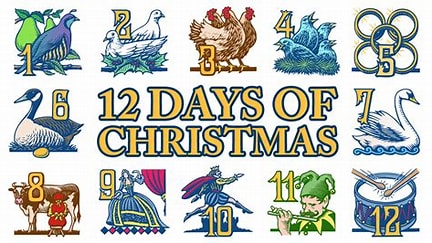
As we journey to know the history behind the lovely song we sing each Christmas…12 Days of Christmas, we journey to know Jesus better through our Christian history.
What a blessing!! The joy of music and God’s endless encouragement makes for a wonderful time to journal such a blessing in our lives!! Our YouTube class runs December 25, 2023 to January 6, 2024…but you can watch anytime as it will always be available on the channel.
You can follow along on my YouTube channel: Josephines Designs or @JosephinesDesignsHL4HonKeto
I also have released a kit if you are in need. If interested, please email JosephinesDesigns@healthyliving4him Please put in the subject like 12 DoC kit and I will gladly answer you email ASAP.
If you have any questions, please email me: JosephinesDesigns.com@healthyliving4him, I am so happy to help.
By the way, a kit is never required for any classes on YouTube. The most important thing is to enjoy your journey and continue to grow in the Word. And as I say often…I pray always that you are encouraged.
Here’s the history of this lovely hymn, the words and a video.
Love and prayers….k 🙂
“Standing on the Promises” was written and composed, in 1886, while Russell Carter was serving as a professor in the Pennsylvania Military Academy, a school in which he had been a member of the first graduating class. The rhythmic martial tone of the hymn’s music possibly reflects Mr. Carter’s military academy experience.
A believer’s stability for this life as well as his confidence for eternity rests solely on the written promises of God’s Word.
It is this reminder of a Christian’s daily dependence upon the promises of God that has made this straight-forward, rhythmical gospel hymn a favorite with God’s people for the past century.
7 Do not be deceived, God is not mocked; for whatever a person sows, this he will also reap.
Tuesday: Hebrews 11:6 New American Standard Bible
6 And without faith it is impossible to please Him, for the one who comes to God must believe that He exists, and that He proves to be One who rewards those who seek Him.
Isaiah 1:18 New American Standard Bible
18 “Come now, and let us [a]debate your case,” Says the Lord, “Though your sins are as scarlet, They shall become as white as snow; Though they are red like crimson, They shall be like wool.
Wednesday: Lamentations 3:22-23 New American Standard Bible
22 [a]The Lord’s acts of mercy indeed do not end, For His compassions do not fail. 23 They are new every morning; Great is Your faithfulness.
Thursday: James 1:5
New American Standard Bible
5 But if any of you lacks wisdom, let him ask of God, who gives to all generously and [a]without reproach, and it will be given to him.
Friday: Titus 1:2
New American Standard Bible
2 in the hope of eternal life, which God, who cannot lie, promised [a]long ages ago,
BONUS:
2 Corinthians 1:20
New American Standard Bible
20 For as many as the promises of God are, in Him they are yes; therefore through Him also is our Amen to the glory of God through us.
DAILY VIDEOS POSTED ON YOUTUBE
DAY 1
#SSBJC2023 BIBLE JOURNALING CAMP DAY ONE: BIBLE STUDY
#SSBJC2023 BIBLE JOURNALING CAMP DAY ONE: BIBLE JOURNALING PT.1
#SSBJC2023 BIBLE JOURNALING CAMP DAY ONE: BIBLE JOURNALING PT.2
DAY 2
#SSBJC2023 BIBLE JOURNALING CAMP DAY TWO: BIBLE STUDY PT1
#SSBJC2023 BIBLE JOURNALING CAMP DAY TWO: BIBLE STUDY PT2
#SSBJC2023 BIBLE JOURNALING CAMP DAY TWO: BIBLE JOURNALING
DAY 3
#SSBJC2023 BIBLE JOURNALING CAMP DAY THREE: BIBLE STUDY
#SSBJC2023 BIBLE JOURNALING CAMP DAY THREE: BIBLE JOURNALING
DAY 4
#SSBJC2023 BIBLE JOURNALING CAMP DAY FOUR: BIBLE STUDY
#SSBJC2023 BIBLE JOURNALING CAMP DAY FOUR: BIBLE JOURNALING
DAY 5
#SSBJC2023 BIBLE JOURNALING CAMP DAY FIVE: BIBLE STUDY
#SSBJC2023 BIBLE JOURNALING CAMP DAY FIVE: BIBLE JOURNALING PT.1
#SSBJC2023 BIBLE JOURNALING CAMP DAY FIVE: BIBLE JOURNALING PT.2




_-_Twelfth-night_(The_King_Drinks)_-_WGA22083.jpg)


 America has become a land of instant everything. One can purchase instant soup, instant coffee, instant iced tea, instant mashed potatoes, and countless other instant items. The advent of the microwave oven also has increased this demand for instantaneous fulfillment. No longer must hungry consumers wait thirty minutes for a meal to be prepared; now they can have it piping hot in only thirty seconds. If Americans cannot have it in an instant, then they do not want it at all.

 Josephine's Designs

